
.svg)

RESOURCE ARTICLE
Top User Onboarding Software Tools for 2026: Improve Retention from Day One
Customer acquisition is becoming more expensive each year. Product teams are under pressure to make sure every new user sees value quickly and stays engaged. This is why strong onboarding is now one of the most important parts of a SaaS growth strategy. The first thirty minutes in the product often determine whether a user will continue, return, or churn. To support this critical stage, companies in 2025 have turned to powerful user onboarding software that simplifies activation, guides users to value, and improves retention from the first login.
This guide takes a close look at the top user onboarding software tools shaping the market in 2026. It also explains what makes each tool unique, what types of companies benefit the most, and how teams can match the right platform to their onboarding strategy.
Why User Onboarding Software Matters in 2026?
Onboarding is no longer just a simple product tour. Modern SaaS users expect experiences that respond to their behavior, guide them at the right time, offer clarity, and respect their pace of learning. Teams also need visibility into how users move through onboarding, which steps create friction, and where intervention is needed. Manual methods cannot support this level of precision, especially at scale.
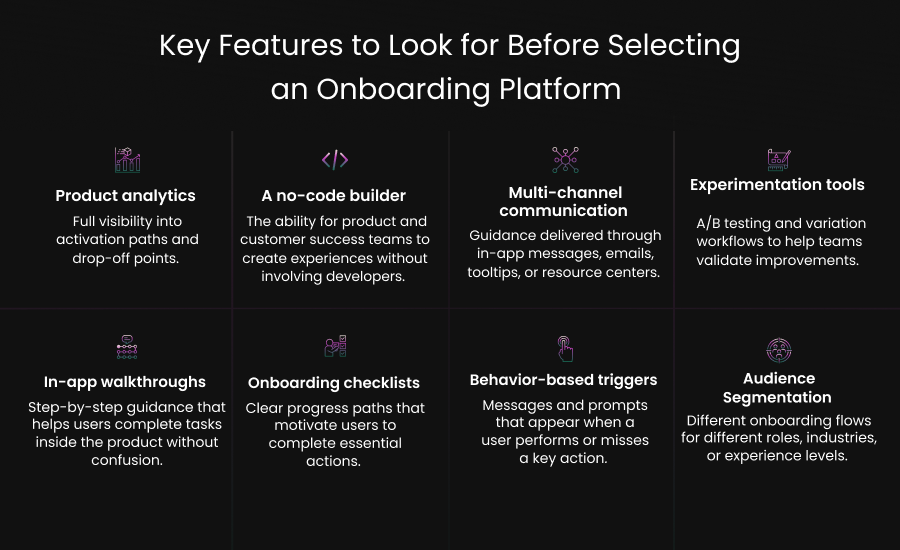
User onboarding software solves these challenges by providing structured in-app guidance, targeted walkthroughs, contextual help, automated checklists, and behavior-based triggers. This creates a smoother learning curve and improves time to value. When onboarding becomes predictable and trackable, product teams can make better decisions and ensure customers stay active long after signup.
Uzera
Uzera has positioned itself strongly in 2025 as a user onboarding software designed for product-led growth, customer success, and activation analytics. Uzera helps SaaS teams understand which users need attention each day and provides a clear view of who is at risk, who is growing, and who is ready for expansion. Its onboarding flows combine simplicity with powerful intelligence, making it a strong option for companies that want an easy-to-use system with serious depth.
Why Uzera Stands Out
- Clean onboarding flow builder that lets teams create checklists, tooltips, and guides without engineering support
- Daily priorities that highlight which accounts need attention to improve retention
- Activation insights that show where users drop off
- Smooth integration with Stripe and major CRMs
- Strong focus on product adoption and long-term retention rather than only first-time guidance
Best For
Startups, growth-stage SaaS companies, and customer success teams that want fast setup, light data requirements, and a practical way to improve onboarding performance.
Userpilot
Userpilot offers a combination of onboarding, product adoption, and feedback tools in a single platform. It is known for balancing simplicity with enough depth for scaling SaaS teams. Userpilot gives teams the freedom to create checklists, modal guides, and contextual help without requiring development time.
Key Strengths
- Behavior-driven experiences that trigger at the right moment
- Checklists designed to speed up activation
- Built-in NPS surveys for capturing feedback
- A/B testing for improving onboarding flows
- Clean interface for managing segmentation and targeting
Best For
Teams that want a strong combination of onboarding and product analytics without needing separate tools.
Userflow
Userflow has gained popularity for its fast and flexible onboarding builder. Teams appreciate how quickly they can create product tours, onboarding checklists, and surveys. The interface is lightweight, which makes it ideal for teams that want to move fast without adding heavy software to their stack.
Key Strengths
- Simple drag and drop builder
- Fast setup that requires almost no engineering support
- Real time previews of onboarding flows
- Checklists that motivate users to complete key steps
- Ability to qualify users with in-app surveys
Best For
Startups and mid sized SaaS companies that want a quick, clean, and easy way to guide users inside the product.
Helppier
Helppier focuses on interactive onboarding content that users can follow with ease. It is well suited for teams that need to educate users through step by step flows and self service tutorials.
Key Strengths
- Guided tours that reduce confusion for new users
- Step based instructions and tutorials
- Support for videos inside the product
- Resource widgets that centralize help content
- Easy setup for non-technical teams
Best For
Companies that want to pair onboarding with strong self training features.
Whatfix
Whatfix is widely used in enterprise environments where onboarding needs to be scalable, consistent, and trackable across thousands of users. It supports both customer onboarding and internal employee onboarding.
Key Strengths
- Personalized walkthroughs that adjust based on actions
- Deep analytics on workflow completion
- Strong support for internal training
- Automated flows that reduce manual steps
- Easy integration with enterprise systems
Best For
Enterprises that need powerful onboarding guidance across multiple systems and teams.
How to Choose the Right User Onboarding Software
Every platform listed above brings real value, but the best choice depends on your product, your team, and your growth goals. Here are practical steps to help narrow your decision.
1. Understand your activation goals
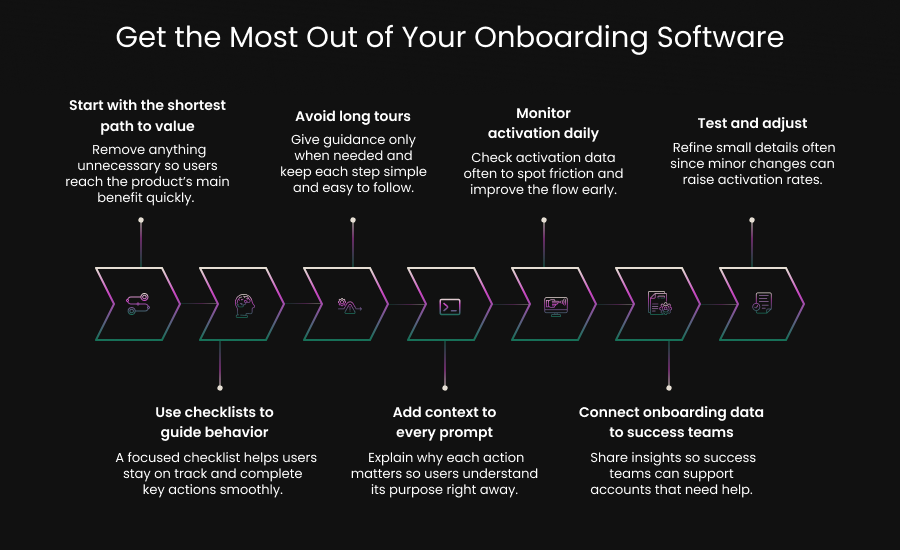
- Before selecting a tool, define what activation means for your product. Map the core actions that lead users to value and choose software that can support that journey.
2. Consider the level of customization you need
- Some products need simple checklists and guides. Others require deep customization that blends into the interface. Look for a platform that matches your design expectations.
3. Evaluate your team’s bandwidth
- If your team has limited engineering support, choose a no code tool. If design precision is required, pick a tool with advanced editing controls.
4. Check analytics coverage
- You need clear visibility into where users get stuck. Make sure the tool you choose offers strong analytics and not just guidance features.
5. Look for scalable pricing
- Your onboarding strategy should grow with your user base. Confirm that the pricing model supports your long term plans without forcing a major shift later.
6. Test the experience as a real user
- Walk through the onboarding flow yourself. If it feels effortless and clear, your users will likely feel the same.
Trends Shaping User Onboarding in 2026
The onboarding landscape is changing fast. These trends are shaping how product teams design first time experiences today.
How Strong Onboarding Improves Retention From the Start?
User onboarding is not just a welcome sequence. It is the moment where you help new customers understand how your product fits into their daily workflow. When onboarding is clear and structured, users feel confident. They begin to see the value the product offers and are more likely to return. When onboarding creates friction or leaves users confused, the risk of churn increases sharply.
Strong onboarding influences several long term outcomes. It improves product adoption. It strengthens customer satisfaction. It reduces reliance on support teams. It also creates a more consistent path for trials to convert into paid customers. In many cases, onboarding becomes the foundation of customer success because it builds the habits that keep users engaged.
In 2026, companies are paying more attention to onboarding because product-led growth continues to rise. The more users who activate early, the stronger the entire customer journey becomes. This is why onboarding software is now seen as a core part of the SaaS stack.
The Future of User Onboarding
Onboarding is becoming smarter every year. Products are learning to respond to user behavior in real time. Guidance is becoming personalized. Activation insights are becoming sharper and more predictive. Companies are moving away from static onboarding and toward flexible systems that adjust themselves based on what each user needs.
As SaaS competition increases, the companies that master early user experiences will stand out. The first fifteen to thirty minutes inside a product will continue to have a major impact on conversion, engagement, and long term retention. For this reason, user onboarding software will remain one of the strongest levers for growth through 2026 and beyond.
Wrapping It Up!
Onboarding shapes a customer’s entire relationship with your product. When this first chapter is clear, simple, and helpful, users feel guided rather than overwhelmed. They see value faster. They return more often. They become long-term customers with stronger potential for expansion.
The tools covered in this guide give SaaS teams the power to build onboarding that works for every type of user. Whether you need a simple onboarding checklist, a behavioral trigger system, or a full digital adoption platform, the right software can transform your activation process.


.svg)

