
.svg)

RESOURCE ARTICLE
The Psychology Behind User Churn: Why Users Leave and How to Stop It
User churn is often treated as a performance issue. Teams look at features, pricing, competitors, or technical gaps to explain why users leave. While these factors play a role, they rarely explain the real decision-making process. Users do not churn because a product lacks functionality. They churn because the experience no longer feels worth their time, attention, or effort.
Understanding user churn psychology means understanding how people evaluate effort versus reward, how confidence is built or lost, and how subtle friction compounds into disengagement. Churn is not a single action. It is the result of a gradual behavioral shift.
This article explores why users decide to leave from a psychological standpoint and how product and experience teams can prevent churn by aligning design and onboarding with real human behavior.
Churn Is an Emotional Decision Framed as a Rational On
When users cancel or stop using a product, they often give logical reasons. It was too complex. It did not fit their workflow. It was not what they expected. These explanations feel rational, but they are usually post-justifications.
The actual decision happens earlier and at a more emotional level.
Users stay with products that make them feel capable, confident, and in control. They leave products that create uncertainty, confusion, or fatigue. Even small moments of friction can trigger doubt. Over time, doubt becomes disengagement.
User behavior churn is driven by how an experience makes someone feel while they are using it, not by a checklist of features.
Churn Rarely Happens All at Once
One of the biggest mistakes teams make is treating churn as a sudden event. In reality, churn is a slow withdrawal process.
It starts with hesitation.
Then, reduced usage.
Then avoidance.
Finally, cancellation or abandonment.
By the time churn is visible in metrics, the psychological exit has already happened.
Most churn triggers appear early, often during onboarding or the first few meaningful interactions. If users feel lost, overwhelmed, or unsure of their progress, they begin to mentally detach. They may still log in, but trust and motivation are already declining.
Stopping churn requires identifying and fixing these early psychological signals.
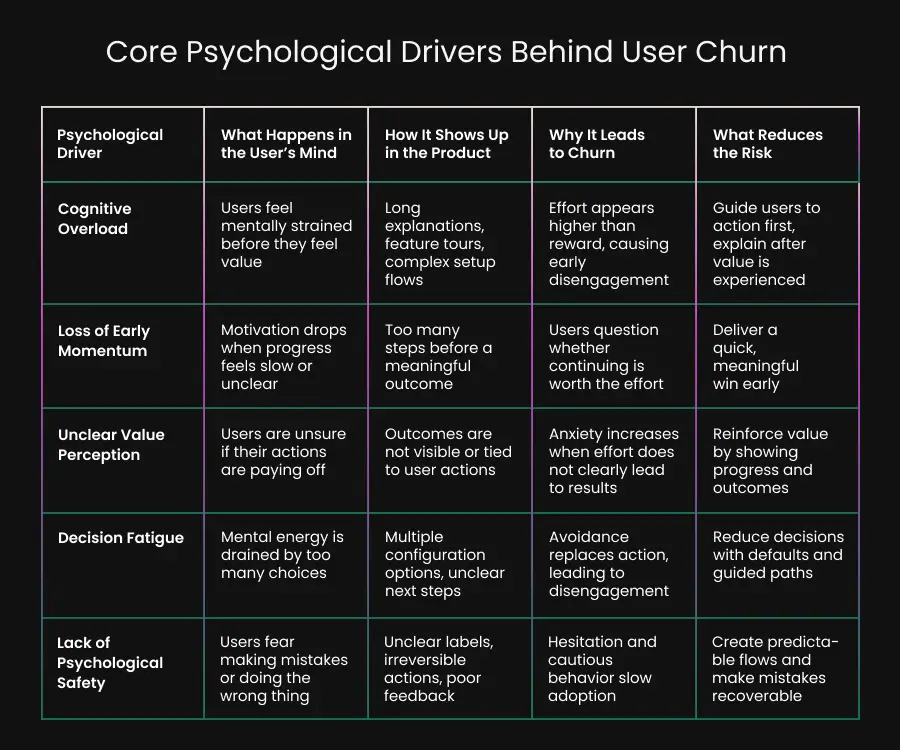
Core Psychological Drivers Behind User Churn
Cognitive Overload
The human brain avoids unnecessary effort. When a product introduces too much information too early, users experience cognitive overload.
This commonly appears during onboarding through long explanations, feature tours, or complex setup flows. Users are asked to understand the product before they have experienced value.
Without context, information feels heavy. Instead of feeling supported, users feel tested. When effort comes before reward, churn risk increases.
Reducing cognitive load means guiding users through action first and explanation second. Learning should follow use, not block it.
Loss of Early Momentum
Momentum is one of the strongest forces in user behavior. When users feel progress, they continue. When progress stalls, motivation drops quickly.
If users do not reach a clear outcome early, they begin to question whether the product is worth continuing. This is not impatience. It is a natural response to uncertainty.
Every additional step between signup and value increases the chance of churn. Each delay weakens commitment.
Strong onboarding focuses on delivering a quick win that feels meaningful. Not a tutorial, but a result.
Unclear Value Perception
Users constantly evaluate whether their effort is paying off. If the value of a product is unclear, users assume it is low.
This does not mean the product lacks value. It means the value is not visible at the right moment.
When users cannot connect their actions to outcomes, they feel like they are guessing. Guessing creates anxiety. Anxiety leads to disengagement.
Clear value reinforcement is critical. Users should regularly see how their actions are helping them achieve a goal, save time, or reduce effort.
Decision Fatigue
Every decision costs mental energy. When a product asks users to make too many choices, especially early on, it creates fatigue.
Common examples include asking users to configure multiple settings, choose between many options, or decide how to proceed without guidance.
Decision fatigue does not cause frustration. It causes avoidance. Users postpone action, then stop returning altogether.
Good experience design reduces decision-making by offering clear defaults and guided paths. Fewer choices often lead to higher engagement.
Lack of Psychological Safety
People avoid environments where they feel they might make mistakes. If a product makes users fear doing something wrong, they proceed cautiously or not at all.
This can happen through unclear labels, irreversible actions, or unclear feedback. When users are unsure what will happen next, they hesitate.
Psychological safety comes from predictability and reassurance. Users need to feel that exploration is safe and mistakes are recoverable.
Products that support experimentation without penalty keep users engaged longer.
Common Churn Triggers That Signal Psychological Breakdown
Churn triggers are not always obvious. Many are small moments that seem insignificant on their own but accumulate over time.
Examples include unclear empty states, lack of feedback after actions, delayed system responses, or inconsistent terminology.
Each of these moments creates micro-friction. Individually, they may be tolerated. Together, they create a sense that the product is hard to use or unreliable.
User churn psychology is shaped by these repeated signals. When friction outweighs perceived value, users leave.
Why Traditional Retention Tactics Often Fail
Many teams respond to churn with reactive tactics. Discount offers, reminder emails, or feature announcements are deployed once users show signs of leaving.
These efforts often fail because they address the symptom, not the cause.
By the time a user considers canceling, their trust has already eroded. An incentive may delay churn, but it rarely restores confidence.
Effective churn prevention starts earlier by designing experiences that prevent doubt from forming in the first place.
How to Stop Churn by Designing for Human Behavior
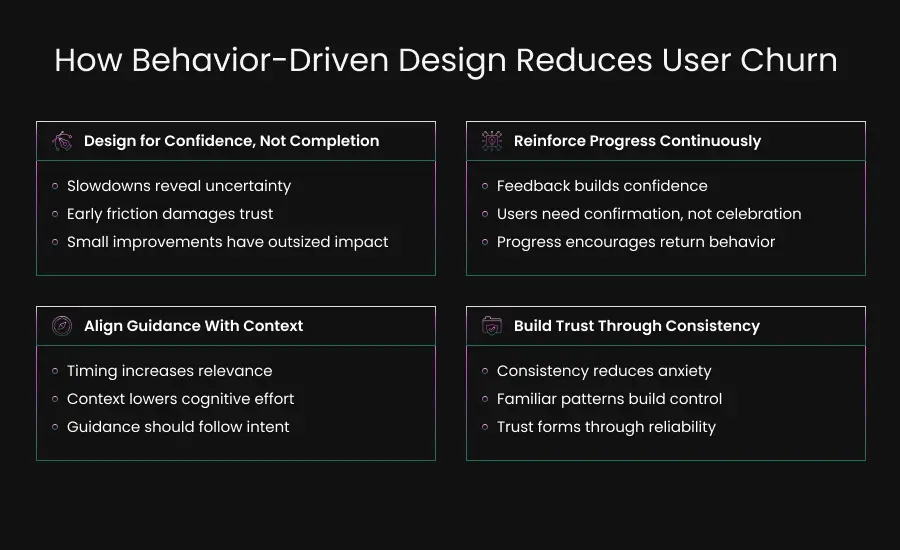
Design Onboarding Around Confidence, Not Completion
Onboarding should not aim for full setup completion. It should aim for confidence.
Users need to feel that they understand what to do next and why it matters. This comes from guiding them toward a meaningful outcome quickly, not from explaining everything upfront.
Action builds understanding. Progress builds motivation.
Reduce Friction at Critical Moments
Pay attention to moments where users slow down or hesitate. These are psychological checkpoints.
Simplify forms. Clarify instructions. Remove unnecessary steps. Small improvements at these points can significantly reduce churn.
Friction is most damaging early in the user journey when trust is still forming.
Reinforce Progress Continuously
People need reassurance that they are moving forward. Clear feedback after actions reinforces confidence.
This can include visual confirmation, success messages, or subtle progress indicators. The goal is not celebration, but clarity.
When users feel progress, they stay engaged.
Align Guidance With Context
Timing matters. Guidance should appear when users need it, not all at once.
Contextual prompts reduce cognitive load and increase relevance. Users are more likely to act on information when it directly relates to what they are trying to do.
This approach respects user attention and reduces overwhelm.
Build Trust Through Consistency
Consistency in language, layout, and behavior creates predictability. Predictability creates trust.
When users know what to expect, they feel in control. Control reduces anxiety and increases long-term engagement.
Trust is not built through promises. It is built through repeated reliable experiences.
Measuring Psychological Health, Not Just Usage
Traditional metrics like daily active users or feature adoption are useful, but they do not tell the full story.
To truly understand user churn psychology, teams need to observe behavior patterns that signal confidence or doubt.
Look for signs like reduced task completion, increased backtracking, or abandoned workflows. These behaviors often appear before churn and reveal where users are struggling.
Qualitative feedback, session recordings, and behavioral analytics provide deeper insight than numbers alone.
Turn Behavioral Insight Into Lasting Retention
User churn is not a failure of technology. It is a misalignment between product design and human behavior.
People leave when an experience feels confusing, effortful, or unrewarding. They stay when it feels clear, supportive, and valuable.
Understanding user churn psychology requires empathy. It requires stepping into the user’s mindset and designing experiences that respect attention, reduce effort, and reinforce progress.
When products are built around how people actually think and behave, churn stops being a mystery and starts becoming a solvable design problem.
Key Behavioral Insights on User Churn
- User churn psychology is driven more by emotions and perception than by features or pricing.
- Churn triggers often appear early as small moments of friction that quietly reduce confidence.
- User behavior churn happens gradually through hesitation, reduced engagement, and withdrawal.
- Onboarding succeeds when it builds confidence and momentum, not when it explains everything.
- Reducing churn requires designing experiences that match how users think, decide, and feel.
Ready to Address Churn at Its Root?
User churn is not a retention problem. It is an experience problem shaped by behavior, confidence, and trust. If users are leaving, there is a psychological reason behind it.
At Uzera, we help teams uncover the behavioral signals that drive churn and redesign experiences to keep users engaged longer. From onboarding to everyday interactions, we focus on fixing the moments where doubt begins.
If you want to reduce churn by aligning your product with real user behavior, let’s start with understanding how your users think.
Frequently Asked Questions
What is user churn psychology?
User churn psychology refers to the emotional and cognitive factors that influence a user’s decision to stop using a product. It focuses on how users perceive effort, value, progress, and confidence over time. Users usually leave not because of one major issue, but because repeated friction and uncertainty reduce motivation to continue.
What are the most common churn triggers from a behavioral perspective?
Common churn triggers include cognitive overload during onboarding, unclear value early in the journey, too many decisions without guidance, lack of feedback after actions, and slow or confusing workflows. These triggers create doubt and mental fatigue, which gradually push users toward disengagement.
How is user behavior churn different from traditional churn analysis?
Traditional churn analysis looks at metrics like cancellations, usage drop, or feature adoption. User behavior churn looks at the actions and signals that happen before those metrics change. This includes hesitation, incomplete tasks, avoidance of key workflows, and reduced confidence during interactions with the product.
Why does onboarding play such a critical role in reducing churn?
Onboarding shapes the user’s first impression of effort and value. If users feel overwhelmed or unsure during early interactions, trust erodes quickly. Effective onboarding builds confidence by guiding users to a meaningful outcome early, reducing mental effort, and reinforcing progress at each step.


.svg)

