
.svg)

RESOURCE ARTICLE
Predictive Analytics vs. AI in Churn Prediction: What Works Best?
Predicting churn is one of the most reliable ways for a SaaS business to protect revenue and keep customers engaged. When users start pulling away, the signals are rarely loud. They appear as small drops in usage, quieter logins, fewer feature interactions, or slower responses during onboarding. The earlier you spot these signs, the better chance you have of guiding customers back to value.
This brings most SaaS teams to crossroads. Should they rely on traditional predictive analytics or invest in modern AI churn prediction models? Both approaches offer value, but they work very differently and support different stages of maturity. The choice often determines how accurately you can identify risk and how quickly you can respond.
This article explains the differences in clear terms. It also breaks down the top churn prediction algorithms, how they operate, and when each option is most suitable for SaaS.
Predictive Analytics and AI: What Sets Them Apart?
Predictive Analytics
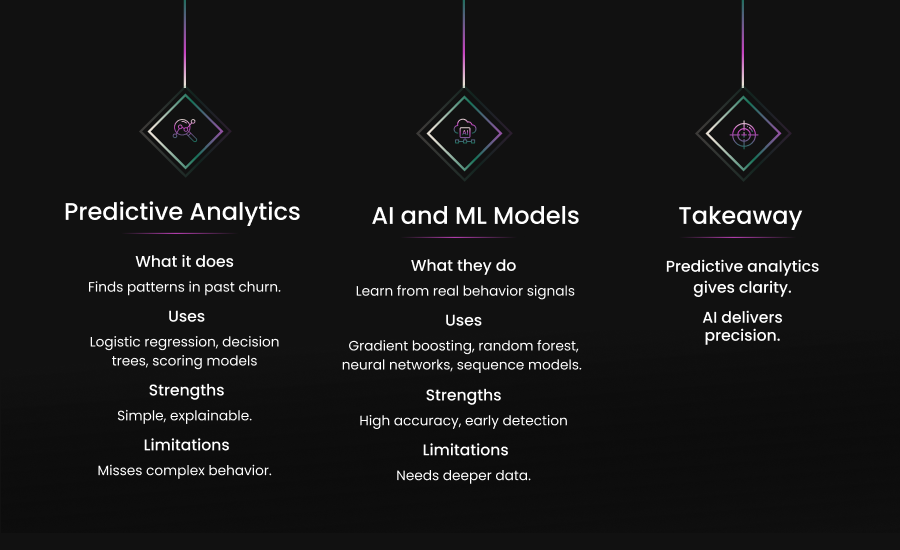
Predictive analytics looks at familiar statistical patterns in historical data. It studies what happened before and tries to find similarities in current behavior. The logic is straightforward. If a customer shows the same characteristics as past users who left, the probability of churn increases.
Most predictive analytics tools rely on:
- Logistic regression
- Decision trees
- Customer scoring models
- Simple trend and usage thresholds
These methods help teams understand broad risk factors and create baseline health scores. The findings are easy to explain to stakeholders because the models reveal why a customer is considered at risk.
The limitation is that predictive analytics does not handle complex behavior well. Modern SaaS applications generate vast amounts of interaction data, and simple rules cannot capture subtle shifts in user journeys.
Artificial Intelligence and Machine Learning
AI and ML churn models learn directly from patterns in real customer behavior. They examine thousands of variables at once, identify subtle movements in usage, and detect risks far earlier than traditional methods.
Modern ML churn models include:
- Gradient boosting algorithms
- Random forest
- Neural networks
- Sequence models that study time-based behavior
- Survival models that estimate when churn is likely to occur
Instead of manual rules, the system learns from actual user journeys and improves as more data flows in. For companies that track deep product behavior, this leads to significantly higher accuracy.
Which Approach Works Best for SaaS?
Predictive analytics works best when your dataset is small or your team is building its first version of a churn model. These models provide clear explanations and are helpful for gaining early visibility.
AI churn prediction is ideal when you capture detailed product usage data and need early signals that humans often miss. SaaS companies with strong analytics foundations, detailed events tracking, and multi-touch customer journeys tend to see the biggest advantage.
Many high growth SaaS teams use both techniques together. Predictive analytics provides the structure. AI expands accuracy, detects hidden patterns, and adapts as user behavior changes.
A Detailed Look at the Top Churn Prediction Algorithms
Below is a breakdown of the most widely used churn prediction algorithms today. Each section covers how the model operates, its strengths and weaknesses, and the ideal use cases for SaaS.
Logistic Regression
Logistic regression is one of the earliest churn prediction techniques. It calculates the probability of churn based on specific input variables like login frequency, ticket volume, or feature usage.
How it works:
The model assigns weights to different variables and uses them to locate risk patterns in current customers.
Strengths:
- Simple to understand
- Works with small datasets
- Easy to maintain
Limitations:
- Cannot model complex behavior
- Predictive power drops as datasets grow in size and complexity
Use for:
Teams that need clarity, not complexity, and want a starting foundation for churn studies.
Decision Trees
Decision trees split data into branches based on conditions. For example, the model may flag customers who logged in less than twice last week and raised two or more support tickets.
Strengths:
- Highly interpretable
- Works well with mixed data types
- Good for explaining risk to leadership and customer teams
Limitations:
- Can overfit
- Not ideal for enterprise-scale prediction
Use for:
Simple, interpretable churn models in low- to mid-sized datasets.
Random Forest
Random forest improves accuracy by combining multiple decision trees. It reduces the risk of overfitting and produces more stable predictions.
Strengths:
- Strong accuracy
- Handles a large number of variables
- Works with moderately messy data
Limitations:
- Less interpretable
- Slower than basic models
Use for:
Companies with multiple data sources, moderate user volume, and established product analytics.
Gradient Boosting Models
Models like XGBoost, LightGBM, and CatBoost are top performers for churn prediction. They build trees sequentially so that each tree corrects errors from the previous one.
Strengths:
- High accuracy across most SaaS datasets
- Works well with imbalanced churn data
- Excellent for behavior-driven churn
Limitations:
- Requires reliable feature engineering
- Computational intensity may increase with scale
Use for:
SaaS companies with steady data flow and detailed product event tracking.
Neural Networks
Neural networks learn non-linear patterns and hidden interactions between variables. When you have large datasets, they reveal patterns that simpler models miss.
Strengths:
- Strong for complex usage behavior
- Learns high-dimensional patterns
Limitations:
- Less transparent
- Requires significant data volume
Use for:
Large SaaS platforms or products with millions of data points per month.
Sequence Models (LSTM and similar)
Sequence models study time based behavior. Instead of looking at data as independent snapshots, they analyze behavioral changes over time, such as:
- gradual drops in usage
- changing feature preferences
- session rhythm
- changes in workflow paths
Strengths:
- Excellent for early churn signals
- Detects behavior shifts that rule-based models cannot see
Limitations:
- Requires structured time-series data
Use for:
Products where customer journeys change week by week, especially during onboarding or account-level transitions.
Survival Analysis
Survival analysis predicts the timing of churn rather than simply flagging risk. This helps customer success teams prepare for renewals, discount windows, and outreach plans.
Strengths:
- Predicts renewal risk windows
- Ideal for annual contract cycles
Limitations:
- Works best with continuous timeline data
Use for:
B2B SaaS with yearly contracts and renewal-driven revenue flows.
Pro Tip: Use simple models like logistic regression and decision trees when you need clarity and fast insights. Shift to boosting models, neural networks, or sequence models once your data volume grows and you want deeper, behavior-driven accuracy.
Comparison Summary
When Predictive Analytics Is the Better Choice
A predictive analytics approach works best when:
- Your data tracking is basic
- Data is mostly numeric and structured
- You are building your first customer health score
- You need clear explanations for leadership
- You want early insights without deep investment
Many young SaaS companies use predictive analytics as a starting step before moving to ML based churn models.
When AI and ML Models Deliver Greater Impact
AI churn prediction is the better option when:
- You capture detailed product usage events
- Your customer journey varies across segments
- You need early signals rather than late reactions
- Your team manages high account volume
- You rely on behavior driven churn insights
As SaaS products grow and collect richer signals, ML churn models outperform traditional analytics due to their ability to learn from complex, nonlinear interactions.
Why Behavior Driven Churn Favors AI
Most modern SaaS churn does not happen suddenly.
It occurs gradually as customers lose confidence, skip key features, delay logins, or fail to achieve value during onboarding. These patterns often look ordinary on the surface. AI models detect slow, progressive shifts that humans overlook, such as:
- Shorter session depth
- Avoidance of key features
- Declining engagement from secondary users
- Shrinking team size within an account
- Drop in onboarding progression
These subtle changes form the core of behavior driven churn, and this is where AI shows its advantage.
Conclusion: Which Method Works Best?
Both predictive analytics and AI based churn prediction have important roles. Predictive analytics provides clarity and direction while AI offers depth and accuracy. The best churn prediction strategy usually combines both.
- Predictive analytics acts as the foundation.
- AI provides the precision.
- Behavior insights create the intervention plan.
Companies that adopt this layered approach often reduce churn meaningfully and strengthen customer retention programs.
Want a clearer way to understand user behavior? Try Uzera.
Uzera helps you see where customers struggle, what they engage with, and when they start drifting away. Its guided onboarding, adoption, and behavior insights make it easier to keep users active and reduce churn.
See how Uzera can support your retention efforts.
Frequently Asked Questions
What is the difference between predictive analytics and AI in churn prediction?
Predictive analytics look at historical patterns and identifies customers who resemble past churners. AI models learn directly from real product behavior, process far more variables, and detect churn signals earlier.
Which churn prediction algorithms are most accurate for SaaS?
Gradient boosting models such as XGBoost, LightGBM, and CatBoost deliver strong accuracy for most SaaS datasets. Sequence models and neural networks perform well when behavior data is deep and time-based.
When should SaaS companies use predictive analytics for churn prediction?
Predictive analytics is best when data volume is small, tracking is basic, or teams need clear explanations behind risk scoring. It works well as an early step before adopting more advanced ML models.
How does AI improve behavior driven churn detection?
AI models detect subtle changes in engagement such as shorter sessions, reduced feature usage, slower onboarding progression, or shifts in team activity. These early signals help SaaS teams act before a customer decides to leave.


.svg)

