
.svg)

RESOURCE ARTICLE
How to Build Onboarding Flows That Actually Convert
There have been numerous instances when good products struggled not because they lacked features, but because users never crossed the line from interest to confidence. Most teams believe onboarding is a short-term checklist. In reality, onboarding flows determine whether a product becomes part of a user’s routine or something they quietly abandon.
Conversion does not happen at signup. It happens when users understand what to do next, why it matters, and how success feels inside your product. That is what strong onboarding flows deliver.
At Uzera, we work with teams who already have traffic, trials, and demand. What they lack is momentum. This article breaks down how to build onboarding flows that move users forward instead of overwhelming them.
Why Onboarding Flows Fail More Often Than Teams Admit
Most onboarding flows are built from an internal perspective. Product teams know the product well, so they explain everything. Users, however, do not need explanations. They need direction.
Here is where most onboarding efforts break down:
- Too many steps shown at once
- Feature tours that explain but do not guide
- Empty states with no instruction
- User onboarding UI designed for completeness instead of clarity
- Activation flows that assume motivation instead of earning it
Users do not abandon products because they are lazy. They leave because they are unsure. Uncertainty kills momentum.
A converting onboarding flow removes uncertainty step by step.
Start With the Outcome, Not the Interface
Before building any onboarding flow, answer one question clearly:
What must a user experience to feel successful for the first time?
This is your activation moment. Not your signup. Not your dashboard view. The moment where value becomes obvious.
- For a CRM, it may be creating and updating a contact.
- For an analytics tool, it may be seeing the first real data set.
- For a workflow platform, it may be completing one task end to end.
Your onboarding flows should be built backward from this moment.
Everything else is noise.
Design Activation Flows That Lead, Not Lecture
Activation flows are not tutorials. They are guided paths.
A strong activation flow does three things well:
- It asks users to act
- It responds immediately to that action
- It shows progress toward a clear outcome
Avoid passive walkthroughs where users click “Next” repeatedly. Clicking without purpose builds zero confidence. Instead, your activation flow should require users to interact with real elements in the product. Fill a field. Upload something. Complete a step that matters.
Confidence grows through action, not observation.
Build User Onboarding UI That Feels Lightweight
Good onboarding UI does not feel like onboarding. It feels like help that appears exactly when needed.
Here are practical principles we follow at Uzera:
- Use in-context prompts instead of modal-heavy tours
- Keep copy short and directive
- Show one task at a time
- Remove unnecessary options until users are ready
- Visually reinforce progress
Your user onboarding UI should feel like a guide standing next to the user, not a manual dropped on their desk.
If your onboarding flow requires a progress bar to convince users to continue, something is wrong.
Personalization Is No Longer Optional
Users arrive with different goals. Treating them the same is a conversion mistake.
Early in the onboarding flow, ask one or two questions that matter. Not demographic questions. Behavioral ones.
Examples:
- What are you trying to achieve today?
- What role best describes you?
- What problem are you solving right now?
Use these answers to tailor the activation flow.
A product that adapts feels intelligent. One that ignores intent feels generic.
Teach by Doing, Not Explaining
One of the biggest conversion mistakes is over-education.
Long tooltips, help articles, and product videos do not activate users. They delay action.
Instead:
- Ask users to complete real tasks
- Confirm success visually
- Reinforce why the action mattered
For example, instead of explaining how a workflow works, guide the user through creating one. Then show the result immediately.
Learning sticks when users experience outcomes, not descriptions.
Measure the Right Onboarding Metrics
Many teams rely heavily on onboarding completion rates and assume the job is done once users finish the flow. This is one of the most common and costly mistakes in product growth.
Completion only tells you that a user reached the end of a sequence. It does not tell you whether the user understood the product, experienced value, or felt confident enough to return.
Completion is not conversion.
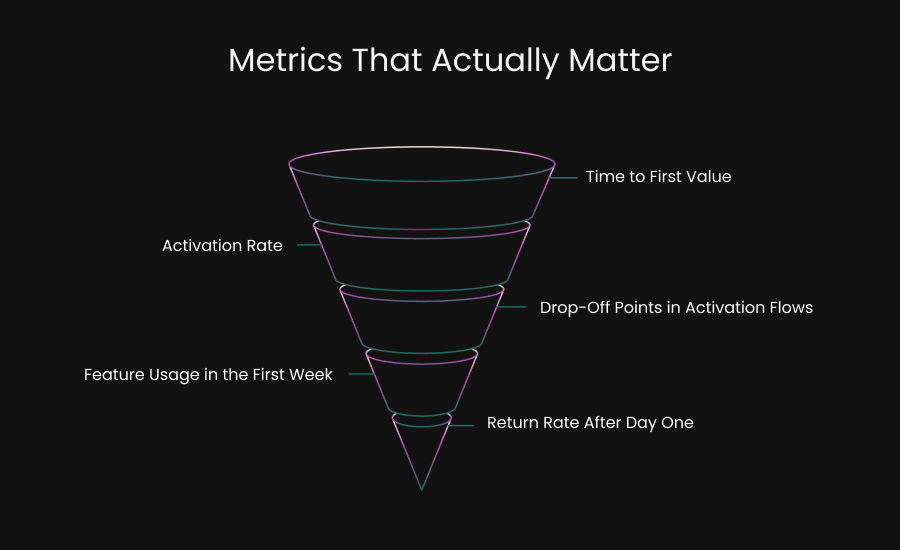
At Uzera, we focus on onboarding metrics that reflect real user behavior rather than surface-level progress. These metrics reveal whether onboarding flows are doing what they are meant to do, which is helping users succeed early.
Time to first value
This measures how long it takes for a new user to reach their first meaningful outcome. The shorter this time, the faster users feel rewarded for choosing your product. Long delays often signal unnecessary steps, unclear instructions, or misplaced setup tasks.
Activation rate
Activation rate shows how many users complete the core action that defines success for your product. This metric matters far more than account creation or walkthrough completion because it reflects actual engagement with value.
Drop-off points within activation flows
Understanding where users abandon onboarding is critical. A spike in drop-offs at a specific step usually means confusion, friction, or a mismatch between expectation and effort. These moments deserve immediate attention, not assumptions.
Feature usage in the first week
Early feature adoption reveals whether users are exploring beyond the minimum. If users activate but never use key features, onboarding may be getting them started without showing them what is possible.
Return rate after day one
This is one of the strongest indicators of onboarding success. If users do not come back after their first session, something failed to stick. Strong onboarding creates a reason to return, not just a reason to finish.
When users complete onboarding but do not return, the flow failed. Not the user.
Onboarding flows should never be considered final. They must be reviewed, tested, and refined continuously based on real usage patterns. Data should guide every improvement, not internal opinions or one-time assumptions.
The goal is not to help users finish onboarding. The goal is to help them move forward with confidence.
Use Friction Strategically
Not all friction is bad.
Sometimes slowing users down improves conversion.
Examples:
- Pausing before account setup to clarify goals
- Requiring one meaningful action before showing advanced features
- Confirming intent before major steps
The key is intentional friction. Every pause should serve clarity.
Unintentional friction, such as confusing UI or unclear instructions, must be eliminated.
Onboarding Does Not End After Day One
This is a critical mindset shift for any team serious about growth. Onboarding flows do not stop once a user completes the first session. In many products, the most important onboarding moments happen after activation, not before it.
Day one is about helping users reach an initial win. The days that follow are about helping that win turn into a habit.
Post-activation onboarding focuses on guiding users as they explore more of the product at their own pace. At this stage, users are no longer learning what the product is. They are learning how it fits into their workflow.
Effective post-activation onboarding includes:
Contextual tips when users explore new features
Guidance should appear when users encounter something new, not all at once. A short prompt or suggestion at the right moment helps users move forward without interrupting their flow.
Gentle nudges toward deeper usage
Not every user will discover important features on their own. Well-timed nudges can encourage users to try the next logical action without feeling pressured or overwhelmed.
Reinforcement of successful actions
Acknowledging progress matters. When users complete a meaningful task, reinforcing that success builds confidence and encourages repeat behavior. This can be as simple as confirming impact or showing results.
Guidance when users stall
Periods of inactivity often signal confusion, not lack of interest. Clear prompts that help users pick up where they left off can prevent drop-off and re-engage users before frustration sets in.
Activation flows help users get started. Ongoing onboarding helps them keep going.
Retention is not the result of one good first impression. It is built gradually through consistent guidance, timely support, and a product experience that continues to feel helpful as users grow.
When onboarding extends beyond day one, users stop feeling like beginners and start feeling capable. That is when real product adoption begins.
Why Most Teams Need to Rethink Onboarding Ownership
Onboarding often sits between product, growth, and customer success. When ownership is unclear, onboarding becomes fragmented.
At Uzera, we treat onboarding as an experience layer that spans:
- Product design
- Behavioral psychology
- UX writing
- Analytics
- Experimentation
Onboarding flows should be owned, measured, and improved like any core product feature. If onboarding is treated as a one-time setup task, conversion will plateau.
Key Takeaways
- Onboarding flows convert when they guide users to action, not when they explain every feature.
- Activation happens when users experience value quickly, not when they complete a checklist.
- Effective user onboarding UI reduces choices, removes friction, and supports progress at the right moment.
- Measuring behavior such as activation, return rate, and time to value matters more than tracking completion.
- Onboarding continues after day one through contextual guidance that builds confidence and long-term adoption.
Build Onboarding That Moves Users Forward
If your product has strong demand but users struggle to activate, the issue is rarely the feature set. It is the experience that guides users from interest to confidence.
Uzera helps product and growth teams design onboarding flows that are built around real user behavior. We focus on activation, clarity, and momentum, not surface-level walkthroughs.
If you want onboarding flows that reduce drop-offs, improve activation, and support long-term retention, let us help you see where your experience breaks and how to fix it.
Start by reviewing your onboarding through the lens of real user actions. The results often speak for themselves.
Frequently Asked Questions
What is the main goal of onboarding flows?
The main goal of onboarding flows is to help users reach their first meaningful outcome as quickly as possible. Effective onboarding reduces confusion, builds confidence, and shows users how the product fits into their workflow. Completion alone does not indicate success unless users experience real value.
How do activation flows differ from traditional product walkthroughs?
Activation flows guide users through actions that matter, while traditional walkthroughs often focus on explaining features. Activation flows require users to interact with the product and see results, which builds understanding and momentum. Walkthroughs may inform users, but they rarely drive behavior change on their own.
What role does user onboarding UI play in conversion?
User onboarding UI influences how easily users can take the next step. Clear, lightweight UI reduces cognitive load, removes unnecessary choices, and provides guidance at the moment it is needed. When onboarding UI is designed for clarity instead of completeness, users are more likely to continue using the product.
How do you know if onboarding flows are actually working?
Onboarding flows are working when users activate, return, and continue using core features after their first session. Metrics such as time to first value, activation rate, and return rate provide stronger signals than completion rates. If users finish onboarding but do not come back, the flow needs improvement.


.svg)

