
.svg)

RESOURCE ARTICLE
How AI Transforms Customer Success: From Churn Prediction to Retention
Customer expectations have shifted quickly, especially in SaaS businesses where users expect intuitive onboarding, proactive support, and continuous value. To meet these expectations, AI customer success tools have become essential. They help teams understand behavior trends, sentiment patterns, and risk indicators that are impossible to track manually.
When used correctly, AI strengthens customer success across the full lifecycle. It supports better SaaS adoption, delivers early warnings for of churn risk, improves customer health scores, and powers targeted churn-reduction churn risk, improves customer health scores, and powers targeted churn reduction strategies that keep accounts on the right path. Instead of reacting to issues late, teams can intervene early with confidence backed by predictive AI insights.
This article explains these transformations in a practical way for customer success leaders, operations managers, and SaaS teams responsible for retention and revenue stability.
Why AI Customer Success Matters Today?
Customer journeys involve more data points than ever. Logins, onboarding milestones, ticket history, feature usage, sentiment shifts, and contract activity all shape a customer’s true engagement level. AI connects these signals and turns them into actionable insights.
According to Harvard Business Review, acquiring a new customer is five to twenty-five times more expensive than keeping an existing one. Retention delivers far greater returns with far less spend.
Traditional success models cannot scale with growing data volume. AI solves this gap by simplifying decision making, improving prioritization, and enhancing SaaS adoption.
How AI Predicts Churn Earlier and More Accurately?
Churn rarely happens overnight. Most accounts show warning signs long before they leave. AI customer success systems detect these early signals by analyzing thousands of data points at once.
Key Signals AI Monitors
AI identifies churn risk by tracking subtle changes in customer behavior long before they become visible to humans. By monitoring the signals below, AI builds a clearer picture of account health and helps teams intervene at the right time.
- Declines in platform logins
- Reduced feature usage
- Drop in engagement from key users
- Slower onboarding completion
- More support tickets
- Negative sentiment in emails or chats
- Contract usage trends
- Delayed payments or shorter sessions
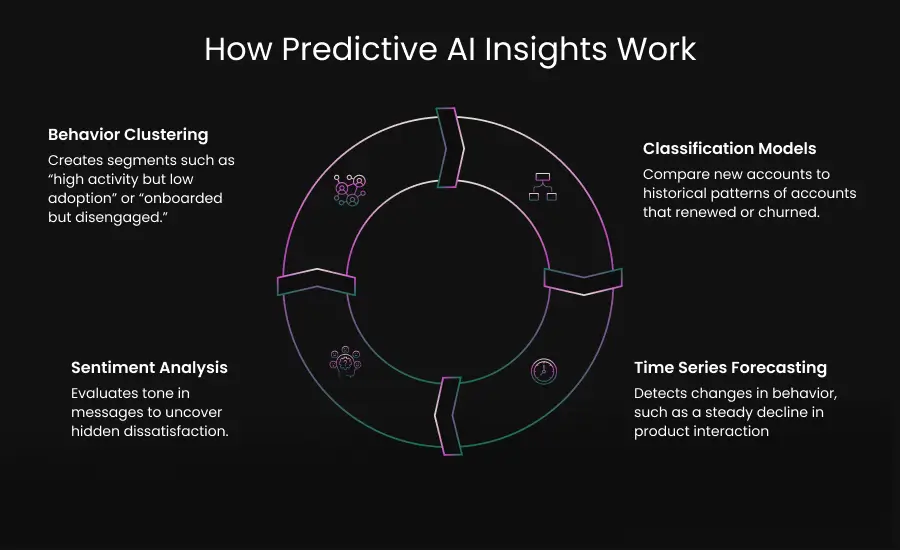
These patterns allow AI tools to assign a churn probability score for each account, guiding teams toward the right churn reduction strategies.
AI Powered Customer Health Scores
Traditional health scoring uses fixed rules that do not keep up with changing customer behavior. AI powered customer health scores update continuously and automatically.
They incorporate:
- Usage depth
- Feature adoption
- Support patterns and sentiment
- Integration progress
- License utilization
- Training completion
- Renewal timelines
- Business outcomes
- Industry benchmarks
- Onboarding performance
AI evaluates the weight of each factor based on the customer’s profile and segment, giving teams a clear view of which customers are thriving and which are drifting.
AI Improves Retention Through Proactive Engagement
The strongest retention programs rely on prevention, not reaction. This is where AI customer success becomes extremely valuable.
1. Early Risk Notifications
AI flags behavior changes instantly so teams can act before dissatisfaction grows.
2. Suggested Actions and Playbooks
AI recommends tasks, training sessions, or follow ups based on customer history.
3. Personalized Engagement Paths
Instead of a single playbook, AI creates custom paths aligned with industry, usage, and maturity.
4. Renewal Likelihood Scores
Teams know which accounts require value reinforcement and which ones are already strong.
5. Prioritization of Accounts
Workload becomes clearer. High value or high risk customers receive timely attention.
These improvements strengthen churn reduction strategies across the entire lifecycle.
AI Strengthens Onboarding and SaaS Adoption
Early experiences shape long term success. Poor onboarding leads to slow SaaS adoption and higher churn. Deloitte estimates that weak onboarding increases churn by 25 percent.
AI improves onboarding by:
- Monitoring milestone completion
- Identifying customers likely to stall
- Detecting obstacles in setup
- Recommending training modules
- Personalizing onboarding flows
- Sending reminders to keep customers engaged
With AI, onboarding becomes structured, predictable, and supportive.
AI Identifies Upsell and Cross Sell Opportunities
AI does not only focus on churn. It also helps teams grow accounts by identifying expansion potential.
Customers often outgrow their original plan. AI catches early signs such as:
- Maxed out usage limits
- Frequent usage of premium features
- More team members needing access
- Industry shifts requiring new tools
- High engagement in certain workflows
Examples:
- A growing construction company may need more device licenses.
- A retail brand expanding locations may need additional automation.
- A SaaS startup reaching API limits may require a larger plan.
These insights allow CSMs to position upgrades as value driven solutions rather than pushy sales actions.
Sentiment Analysis Helps Strengthen Trust
Customer language reveals a lot about future outcomes. Even messages that appear neutral may contain frustration or concern.
AI evaluates sentiment across:
- Emails
- Support chats
- NPS comments
- Survey responses
- Meeting transcripts
- Social messages
Patterns such as declining confidence, urgency, or dissatisfaction help teams improve the relationship before issues escalate.
Studies from NIST show that language signals can predict negative outcomes earlier than behavior data. This makes sentiment analysis an essential part of AI customer success.
Manual Customer Success vs AI Customer Success
High Touch and Tech Touch Both Improve with AI
AI does not replace Customer Success Managers. It strengthens their impact by giving them better visibility, sharper insights, and structured guidance. Instead of relying on intuition or scattered data, teams can approach every interaction with clarity and confidence.
High touch accounts benefit the most from this intelligence. CSMs can walk into business reviews with precise adoption metrics, sentiment signals, workflow insights, and predictive indicators. This allows them to act more like strategic advisors who guide customers toward long term value. Conversations become less about troubleshooting and more about growth, efficiency, and future planning.
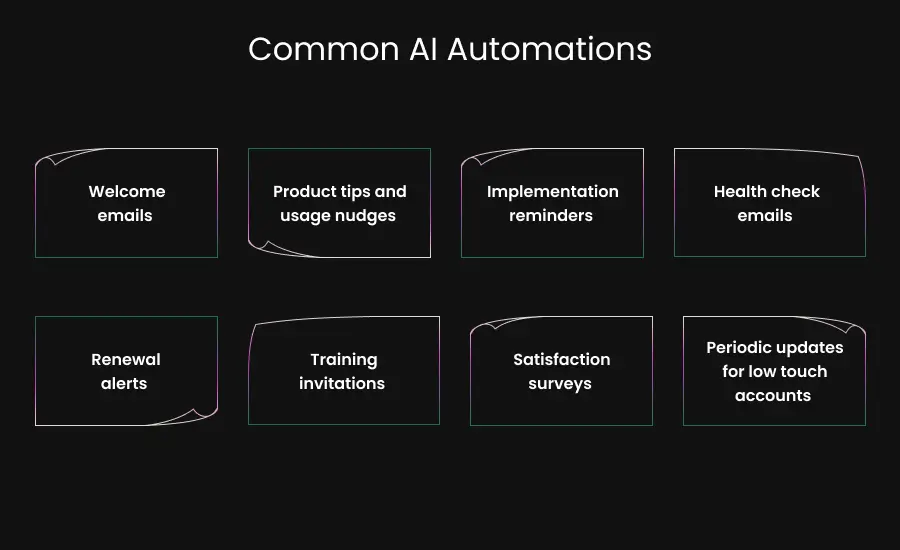
Tech touch accounts also see major improvements. AI enables automated nudges, relevant tips, onboarding reminders, and personalized learning paths that fit each customer’s usage patterns. Even low touch customers receive timely and meaningful engagement, which supports stronger SaaS adoption without increasing team workload.
By powering both engagement models, AI ensures that every customer receives the right level of support at the right time. It brings consistency to outreach, depth to insights, and efficiency to the entire success operation.
Wrapping It Up!
AI customer success has moved from being optional to becoming a core driver of retention and growth. It helps teams understand customer behavior more clearly, detect churn risks earlier, support SaaS adoption, generate accurate customer health scores, and build long term relationships through personalized engagement.
Organizations that combine human expertise with predictive AI insights gain a significant advantage. They create a customer experience that feels proactive, supportive, and reliable. As expectations continue to rise, AI driven success becomes the foundation of strong retention, higher lifetime value, and stable revenue.
Frequently Asked Questions
What is AI customer success?
AI customer success uses automation, predictive modeling, and sentiment analysis to improve retention, health scoring, and customer engagement.
How do predictive AI insights help reduce churn?
They uncover early warning signs and give teams enough time to intervene.
Can AI improve SaaS adoption?
Yes. AI personalizes onboarding and sends nudges that help customers reach value faster.
What factors shape customer health scores?
Usage depth, sentiment, support activity, adoption, integrations, and renewal behavior.
Are AI churn reduction strategies reliable?
Yes. AI analyzes historical patterns and current data to generate accurate risk predictions.


.svg)

